
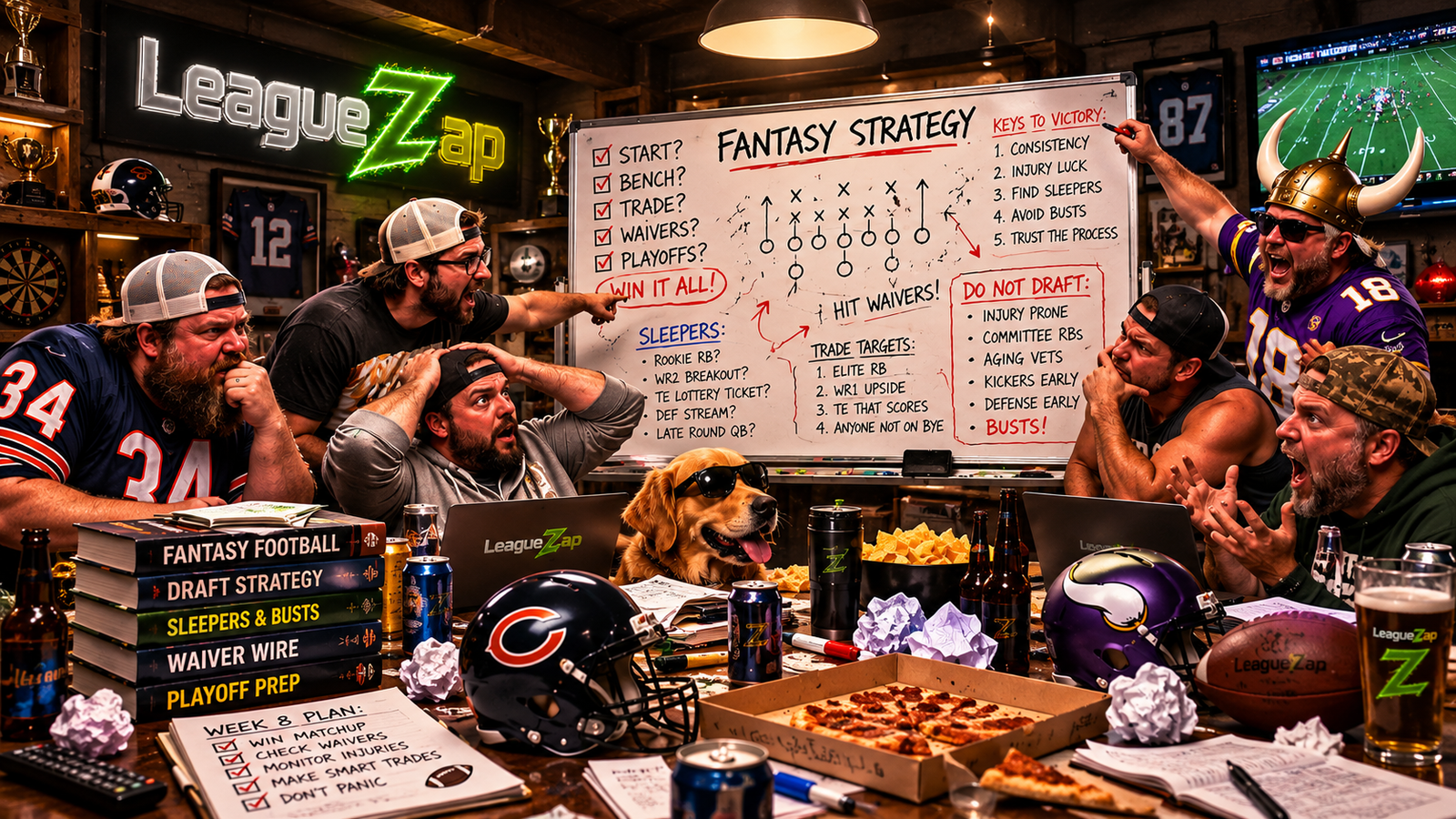
Somewhere in America, a 38-year-old man wearing sweatpants is screaming at a television because a professional football coach with 27 years of experience has decided to run the football on third-and-two.
The man, who has never attended a professional football practice, studied an NFL playbook, or successfully assembled a piece of IKEA furniture without consulting YouTube, is absolutely certain the coach is an idiot.
He knows this because his fantasy running back needed six more points.
Welcome to fantasy football, a multibillion-dollar ecosystem built on the extraordinary premise that ordinary Americans possess superior football intelligence because they know how to operate a smartphone application.
These men are not merely fans.
They are general managers. Talent evaluators. Statistical analysts. Offensive coordinators. Visionaries.
At least according to themselves.
To everyone else, they are grown adults arguing over whether a 24-year-old millionaire should have caught a football thrown by another millionaire so they could defeat a coworker named Randy.
THE SCIENCE OF BEING COMPLETELY WRONG
Modern fantasy football managers have access to more statistical information than any generation in human history.
Targets. Snap shares. Route participation. Air yards. Red-zone utilization. Expected fantasy points. Defensive matchup grades. Weather conditions. Offensive line rankings. Strength of schedule.
They consume all of it.
They understand approximately none of it.
Every Tuesday, thousands of fantasy managers open elaborate spreadsheets containing enough data to launch a small satellite. By Sunday evening, they will have lost to a man who forgot to change his lineup because he was fishing.
This does not discourage them.
In fact, it reinforces their belief that the system is fundamentally unfair.
“I made the mathematically correct decision,” explains a hypothetical fantasy manager who has finished 4-10 in three consecutive seasons. “The process was sound.”
The process, apparently, involves selecting players who do not score points and then explaining why this was actually intelligent.
Fantasy football is perhaps the only competitive activity in which repeatedly being wrong can serve as evidence of superior expertise.
THE YOUTUBE UNIVERSITY OF FOOTBALL INTELLIGENCE
No examination of fantasy football culture would be complete without acknowledging its most influential institution: a 26-year-old YouTuber recording start/sit recommendations from a bedroom illuminated by purple LED lights.
Every week, millions of fantasy managers consult these digital prophets for guidance.
“START THIS GUY IMMEDIATELY.”
“THE SECRET LEAGUE WINNER NOBODY IS TALKING ABOUT.”
“FIVE PLAYERS YOU MUST BENCH THIS WEEK.”
The thumbnails feature a man pointing aggressively at a professional athlete while displaying an expression normally associated with discovering a house fire.
The information is revolutionary.
Start good players.
Avoid injured players.
Consider favorable matchups.
For this groundbreaking analysis, the fantasy community offers its gratitude, subscriptions, and occasionally money.
By Sunday afternoon, when the recommended sleeper has recorded one reception for four yards, the manager faces an important decision.
Accept personal responsibility?
Absolutely not.
The YouTuber ruined his season.
By Tuesday, the manager will be watching the same channel again.
THE SECRET LEAGUE WINNER EVERYONE KNOWS ABOUT
Every fantasy manager believes he possesses classified information.
He has identified a breakout candidate.
A hidden gem.
A generational talent buried on the depth chart.
A player whose advanced metrics suggest an imminent statistical explosion.
He discovered this athlete through an obscure research method known as listening to the same podcast as 400,000 other people.
The player is now being described as a “secret league winner” by seventeen YouTube channels, nine fantasy websites, six podcasts, and a man selling a $39 draft guide.
The secret is apparently being protected with the same level of discretion as a Super Bowl halftime announcement.
Nevertheless, our fantasy expert remains convinced he has uncovered something extraordinary.
“Nobody is talking about this guy,” he announces in a group chat where six people have already discussed the guy.
He selects the player in the ninth round.
The player finishes the season with 183 receiving yards.
“Next year,” the manager says, “he’s going to explode.”
PROFESSIONAL ATHLETES ARE NOW PERSONAL PROPERTY
Perhaps the most fascinating aspect of fantasy football is the language managers use when discussing actual human beings.
“I own Josh Allen.”
“My receivers are terrible.”
“I need my running back to produce.”
“I’m dropping him.”
“I’m trading him.”
These are professional athletes who have dedicated their lives to reaching the highest level of their sport.
They train year-round. Endure injuries. Study complicated systems. Perform under enormous pressure in front of millions of people.
And somewhere in Ohio, a man named Keith believes he has the authority to describe one of them as “completely useless” because he scored 8.7 fantasy points.
Keith, for context, becomes winded carrying groceries upstairs.
He nevertheless believes his roster is an elite collection of assets under his personal command.
The players have never heard of Keith.
They do not know he owns them.
They are unaware that their performances are being monitored by a man whose team name is Fourth and Hungover.
But Keith is furious.
And Keith demands accountability.
THE WAIVER WIRE: WHERE DESPERATION BECOMES STRATEGY
Every Wednesday morning, fantasy managers participate in what can only be described as an elaborate ritual of collective delusion.
The waiver wire opens.
A backup wide receiver has caught two touchdowns because three starters were injured.
He is now the most important player in America.
Managers submit claims. Spend precious waiver budgets. Rearrange rosters. Consult experts. Debate projected target shares.
By Thursday, the player has been declared a league winner.
By Sunday, he has returned to his natural position on the depth chart.
By Monday, he is available again.
The cycle repeats.
No one questions the system.
THE TRADE OFFER THAT INSULTS HUMAN INTELLIGENCE
Fantasy managers also pride themselves on their negotiating skills.
Consider the standard trade proposal.
One manager offers three bench players, two of whom are questionable with hamstring injuries, in exchange for the league’s highest-scoring running back.
He describes this as “a fair deal with tremendous upside.”
When the opposing manager declines, he becomes offended.
“Nobody in this league knows how to trade,” he announces.
What he means is that nobody is willing to exchange a valuable player for three people he was planning to release.
The rejected offer will become the subject of a 45-minute conversation about market inefficiencies.
He will then propose the same trade to someone else.
THE INJURY REPORT IS A PERSONAL ATTACK
In ordinary society, when a professional athlete suffers an injury, people generally express concern for his health and recovery.
Fantasy managers have developed a more efficient emotional process.
“ARE YOU KIDDING ME?”
The injured player, perhaps suffering a torn ligament, has committed an unforgivable offense against a man sitting in a recliner.
The manager immediately checks the injury timeline.
Not because he is concerned about the athlete’s future.
Because he needs to know whether the player will be available for Week 11 against a guy named Big Daddy Touchdowns.
The athlete’s family hopes for a full recovery.
The fantasy manager hopes for a questionable designation and limited practice participation by Friday.
THE CHAMPIONSHIP PARADE THAT NEVER HAPPENS
By Week 14, the fantasy football community has divided into three distinct groups.
The first consists of managers who have qualified for the playoffs and are now describing themselves as dangerous.
The second consists of managers who missed the playoffs because of injuries, officiating, coaching decisions, bad luck, scheduling, weather, and a series of statistical anomalies that have absolutely nothing to do with their own decisions.
The third consists of the one manager who autodrafted, made two waiver claims all season, and is somehow 11-3.
Nobody likes the third manager.
He is everything the fantasy football establishment fears.
Proof that their carefully constructed intellectual universe may be held together with nothing more than probability, coincidence, and extremely loud opinions.
When the championship concludes, one manager will emerge victorious.
He will celebrate as though he personally engineered the Kansas City Chiefs’ offensive system.
He will post screenshots.
He will demand respect.
He may purchase a trophy.
For the next eight months, he will introduce himself as a champion.
His family will endure this.
AN INDUSTRY BUILT ON UNBREAKABLE CONFIDENCE
And yet, despite the questionable expertise, the catastrophic predictions, the imaginary ownership of professional athletes, and the weekly emotional collapses, fantasy football continues to thrive.
Perhaps that is its greatest achievement.
It has convinced millions of ordinary people that they are brilliant football strategists while simultaneously providing overwhelming evidence to the contrary.
Every year, managers return.
They study harder.
They purchase more draft guides.
They subscribe to more podcasts.
They construct increasingly elaborate statistical models.
They promise themselves that this season will be different.
And every year, someone who picked players based on their favorite team colors finishes ahead of them.
Still, they persist.
Because somewhere deep inside every fantasy football manager lives an unshakable belief.
That he understands football better than the coaches.
Better than the analysts.
Better than the scouts.
Better than the general managers.
And certainly better than the other nine idiots in his league.
He does not.
But he has a spreadsheet suggesting otherwise.
And next year?
Next year, he’s winning the whole damn thing.
LeagueZap Newsroom is proud to serve a fantasy football community filled with dedicated managers, passionate competitors, and approximately zero people willing to admit they have absolutely no idea what’s going to happen on Sunday.
All characters depicted are fictional. Any resemblance to an actual fantasy football manager is statistically inevitable.